Is the AI memory crisis waiting at the door of SAP HANA hardware refreshes?
Memory prices keep breaking records. A thought experiment on what that means for refreshing in-memory SAP HANA servers and for HANA capacity in the cloud.
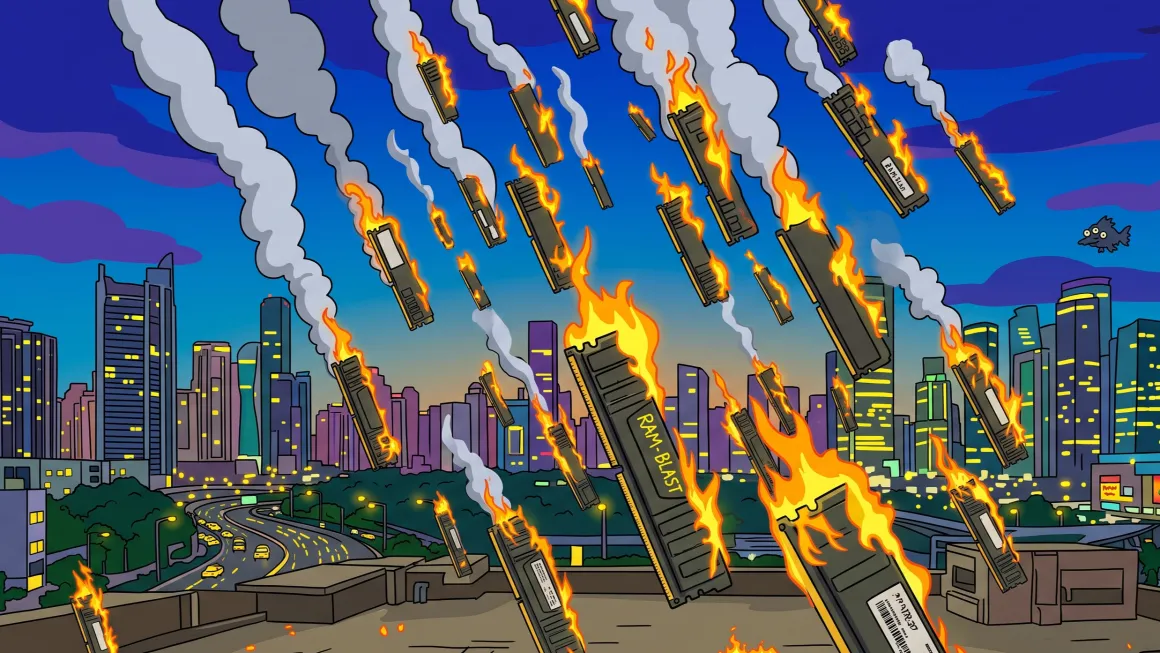
Memory prices are breaking one record after another, so let’s do a thought experiment on what that means for the running costs of SAP HANA servers, which work entirely in memory.
First, why are memory prices rising, and how did we get from 2025 to 2026? A short recap: AI hardware uses HBM (High Bandwidth Memory), which is vertically stacked DRAM. HBM demand is now so high that the three major manufacturers have shifted production capacity to it. At its earnings call last October, SK Hynix said its capacity for 2026 was effectively sold out. Micron left the consumer memory market altogether to focus on enterprise and AI customers. Gartner forecast a 47% rise in DRAM prices for 2026.
The HBM in AI hardware and the DDR in servers are not the same thing, but they come off the same wafers. One GB of HBM consumes roughly three times the wafer capacity of one GB of DDR5. So HBM is not an alternative to the DDR5 RDIMMs that S/4HANA runs on, but it competes with them for production capacity. HANA doesn’t use HBM, yet the more HBM gets made, the tighter the supply of the DDR that HANA needs. That is exactly where we should be looking.
Between early 2025 and Q1 2026, DDR5 contract prices rose more than 100%. Counterpoint Research expects the DDR5 64 GB RDIMMs common in data centres to cost twice their early-2025 price by the end of 2026. TrendForce expects conventional DRAM contract prices to rise 13–18% quarter over quarter in Q3 2026. That is a clear slowdown from the ~60% jump in Q2, but note that Gartner’s 47% full-year forecast from January was overtaken in a single quarter. And the slowdown comes from demand running out, not from supply. According to the report, the cooling isn’t due to better supply but to consumer electronics makers being unwilling, and unable, to absorb higher memory costs after months of price hikes. So it’s more accurate to say “the consumer side gave up” than “the crisis is easing.”
Server DRAM has one positive point: TrendForce says the server DRAM supply gap will persist into Q3, but because part of the purchasing runs under long-term supply agreements, price increases will be more controlled. In effect, long-term agreements put a ceiling on server DRAM prices. Keep in mind, though, that this partial relief doesn’t apply to enterprise buyers without an LTA. Those with one are comfortable for now: Microsoft’s three-year DDR5 contract with SK Hynix, worth tens of billions of dollars, includes a floor price guarantee and 10–30% prepayment. Google has a five-year standard DRAM agreement with SK Hynix. That is the hyperscalers’ short-term buffer.
At Samsung’s Q2 2026 earnings presentation, Jaejune Kim, EVP of the memory business, said supply constraints would be more severe in 2027 than in 2026 and the shortage would last until 2028. Because it takes more than three years to go from building a fab to producing wafers, no meaningful capacity increase is expected in that window. Kim also said almost every customer is asking for multi-year contracts, and that the company aims to lock about two thirds of its long-term output into such deals. That means contracts of at least five years, with prepayment and a floor price guarantee.
So the first half of 2026 is over. Is there light at the end of the tunnel?
Presenting Q2 2026 results, the CEO of memory module maker ADATA said the 2027 capacity of the three big DRAM makers (SK Hynix, Micron and Samsung) is already sold. SK Hynix’s CEO called 2027 the industry’s worst shortage year. Frankly, after reading those statements, I still don’t see any light.
One note belongs here, though: China’s CXMT has established itself as a fourth player in what was a three-player market. Counterpoint’s “AI Demand Reshapes DRAM Rankings in Q2 2026” report, published on 3 August, puts Q2 2026 revenue shares at Samsung 39%, SK Hynix 26%, Micron 25% and CXMT 7%. CXMT’s revenue grew more than 700% year over year, but its quarterly share slipped from 8% to 7%: the big three’s price gains outweighed its volume growth. Still, CXMT today mostly makes commodity DDR4/DDR5 DRAM, not HBM. It is the only meaningful new capacity adding volume to conventional server DRAM right now. If export controls and enterprise supplier qualification allow, CXMT could ease the pressure on DDR5 RDIMMs in the medium term.
Now back to SAP S/4HANA. When the servers of in-memory SAP HANA databases, which need terabytes of memory, come up for refresh, you may well face prices you didn’t expect. Even if it hasn’t hit you yet, there is a chance of a surprise when you next get a quote to refresh your S/4HANA hardware or add capacity in the cloud. Add the memory for quality, development and DR systems to the BOM on top of production, and the cost impact multiplies.
Having sat on both sides of enterprise pricing strategy for years, I can say this plainly: when you go to tender, the contract length, market dynamics and the vendor’s targets for the period all change the offer a customer sees. So it pays to build your RFP and cost projections like a chess player, looking at them from several perspectives.
Now the cloud side:
OVHcloud is not the main home of enterprise SAP workloads, but it is the only provider that published its old and new prices side by side, which makes it the clearest indicator we have. Hyperscalers buy the same components from the same manufacturers; what sets them apart is the time buffer their long-term agreements give them.
OVHcloud’s new price list, published on 5 March 2026 and effective 1 April, announced a 9–11% increase in the headline. Open the tables and you see the pricing logic split in two: virtual machine prices, memory-optimised ones included, went up a flat 10%. On bare metal RAM options, though, the increase is 50% at 256 GB and 145% at 1 TB and above. The total monthly price of a server with 3 TB of memory rose 120%. In short, the bigger the memory share, the steeper the increase, and HANA configurations sit at the steepest end of that curve. AWS, Azure and Google Cloud haven’t announced instance price increases yet; AWS, however, raised EC2 Capacity Blocks prices twice in 2026 (~15% and ~20%), citing “supply and demand dynamics” in the announcement.
In the long run I expect all of them to follow similar strategies. But the hyperscalers’ ongoing contracts with hardware makers and with large customers such as SAP should hold prices in place in the short to medium term. After that, the cards will be dealt again.
One more thing: as with private schools, customers with a running contract see predictable increases, while new customers or those up for renewal may get a surprise. OVHcloud’s list shows this clearly: for existing customers renewing options, the increase is capped at 15% for RAM and 10% for disk, while new orders pay the full price, up to 145% more.
The same logic will likely apply to hyperscaler committed-use commitments, but we can’t forecast that yet because no increase has been announced. How RISE contracts will pass this cost on at renewal is a black box, since SAP publishes no list price for that product. In this period, your contract calendar will matter as much as your technical architecture.
So what can be done about all this: data tiering, sizing discipline, contract timing? Let that be the subject of another post.
Sources
- TrendForce, “Long-Term Agreements Cap Price Increases; Server DRAM Contract Prices Expected to Rise 13-18% QoQ in 3Q26” (9 July 2026)
- Counterpoint Research, “AI Demand Reshapes DRAM Rankings in Q2 2026” (3 August 2026)
- OVHcloud, “Pricing changes for Public Cloud, Bare Metal and VPS at OVHcloud”, Octave Klaba (5 March 2026)
- Network World, “Samsung warns of memory shortages driving industry-wide price surge in 2026” (7 January 2026)
First published on LinkedIn on 5 August 2026, in Turkish.